Match engine · 11 min read
How the match engine works
Every Swish & Dunk game is simulated possession by possession — not decided by one dice roll on team Overall. This page explains what happens inside a game and which numbers matter, so you know exactly what your lineup, tactics and roster decisions change.
Update, October 2026: the engine has been recalibrated against real NBA statistics, with a faster pace, modern shot selection, stronger stars and closer finishes. Read what changed in the new match engine.
Update, November 2026: you now set every player's minutes yourself, nobody plays more than 38 minutes in regulation, all 49 ratings count on the court, and blowouts end with both benches on the floor. Everything on this page reflects these changes.
Key numbers
- 4 quarters of 12 minutes; a tied game goes to 5-minute overtimes until there is a winner.
- 49 ratings per player, each on a 1–100 scale, all of them used in the simulation.
- Base odds: 56% on close shots, 37% from mid-range and 31.5% from three, then shifted by the matchup and by the shooter's height near the rim. At the line a 70 Free Throw rating shoots about 78%.
- No player goes past 38 minutes in regulation.
- Fatigue can cut a player's ratings by up to 30%.
- Home court: +1.2% on every rating of the home team.
- Clutch time: the last 5 minutes of the fourth quarter or of an overtime, with the margin at 8 points or fewer.
- 7 timeouts per team, used to stop the opponent's runs.
- Six personal fouls and a player is out of the game.
A game, step by step
- Loading the teams. The engine loads both active rosters, each club's rotation (starting five, the players behind them at every position and the minutes the manager set for each) and its offensive and defensive tactics. The minutes are scaled so the team adds up to 240. If a club has not set a rotation, one is built automatically from player Overall. Players left out of the rotation get a target of zero: they only come in for emergencies.
- Tip-off. Every player starts at 100 stamina and the first five in the rotation start on the floor. If a saved starter is missing (injured or sold), one player steps up in his place, taking his minutes: the next one in the same slot, or the best bench player who covers that position. A starter coming back after 10 or more straight games on the bench is rusty and plays the first quarter at 85% of their ratings.
- Quarter by quarter. Each quarter is played possession by possession until the clock runs out. After every possession the engine updates the score, plus/minus, minutes and stamina, checks substitutions and gives the ball to the other team — unless the offense grabbed the rebound.
- Overtime. If the score is tied after 48 minutes, the teams play 5-minute overtime periods until one of them wins.
- Final buzzer. The engine saves the final score, the quarter-by-quarter line, the box score of every player and the full play-by-play. That is exactly what you watch in the replay.
Inside a single possession
A possession is a chain of small matchups — “duels” — between an attacker and a defender. Every duel starts from a base rate and moves with the difference between the two ratings involved:
probability = base rate + (attack rating − defense rating) ÷ 400 → kept between 1% and 99%
So a 20-point edge in a matchup moves the odds by 5 percentage points. Over a hundred-plus possessions, those small edges decide games.
- Transition or half-court. About 15% of possessions start as a fast break, scaled up or down by your offensive tactic's transition tendency.
- Who has the ball, and which play. The engine picks the ball handler from the players on the floor, weighting position and ratings, then picks the play: isolation, pick-and-roll, post-up, catch-and-shoot or transition. Each play is weighted by the ratings that matter for it — isolation, for example, leans on shooting off the dribble and ball handling.
- The defense. A primary defender is assigned, normally the opponent at the same position.
- Turnover check. Ball security against defensive pressure, starting from a 12% base rate. Basketball IQ, ball security and decision making all help the ball handler; on isolations and pick-and-rolls Weak Hand counts too, because a defender who takes away the strong hand forces the ball into the other one.
- Shot selection. Close, mid-range or three, weighted by the shooter's ratings, his position and your tactic's three-point and paint tendencies: bigs live at the rim, wings take threes, few shots come from mid-range. A ball handler who drives on an isolation or a pick-and-roll gets to the rim more often the higher his Acceleration, and finishes with his weak hand 30% of the time.
- Make or miss. The base rate for the shot type, moved by the shooter-versus-contest duel.
- Fouls. Shooting fouls start from a 6% base rate, almost half again as likely on shots at the rim, and can turn into an and-one. Non-shooting fouls start from 7.5% and can be called on any defender, not only the one guarding the ball; from the fifth team foul in a quarter, every foul sends the other team to the line.
- Rebounds. On a miss, the offense grabs the ball back roughly a quarter of the time, more or less depending on the offensive rebounding, box-out and strength of the ten players on the floor.
What your ratings and choices change
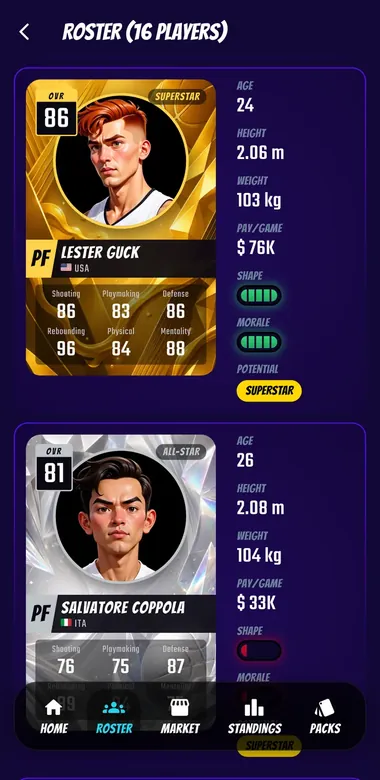
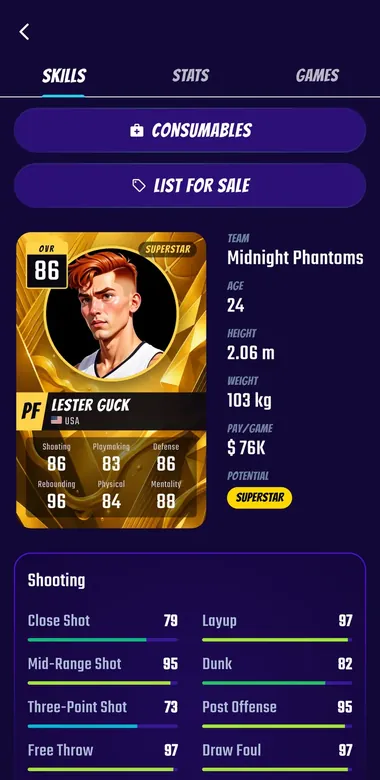
- Ratings. 49 ratings per player on a 1–100 scale: shooting (close, mid-range, three, free throws, off the dribble, catch-and-shoot, post, weak hand), playmaking (ball handling, passing, vision, ball security), defense (perimeter, interior, post, pick-and-roll, steals, blocks, contests), rebounding, athleticism (speed, acceleration, strength, stamina, vertical) and mental attributes. Since November all 49 count on the court or off it: Post Defense guards the block, Pick & Roll Defense shares the contest after a screen with the on-ball defender, Work Ethic and Coachability speed up growth, and Professionalism decides how much morale and game shape a player loses when he sits or plays too much.
- Fatigue. A player's effective ratings drop as their stamina runs down during the game — up to 30% on an empty tank. A high Stamina attribute softens that drop by up to 60%, and players recover while they sit on the bench.
- Game shape and morale. A player's physical condition scales every rating from 0.90 (poor) to 1.00 (excellent), and low morale can take up to another 10% off.
- Home court. The home team gets +1.2% on every rating. Small on its own, noticeable across a whole game.
- Tactics. Swish & Dunk has 15 offensive and 8 defensive systems, all compared in the tactics guide. Offensive systems change pace, three-point and paint tendencies, pick-and-roll usage, transition, ball movement, turnover risk and offensive rebounding. Defensive systems change pace, perimeter and interior contests, how many turnovers you force, your foul rate and defensive rebounding.
What each of the 49 ratings does, one by one, and where the engine uses it is explained in our complete guide to player skills.
Hot nights and cold nights
Before tip-off every player gets a “night” modifier, drawn once and kept for the whole game. It comes from the Consistency rating: a very consistent player swings by about ±3% at most, a streaky one by up to ±23%. The draw is bell-shaped, so extreme nights are rare.
The swing applies in full to shooting ratings and only one third to everything else: a player with a cold hand still defends and passes. All effective ratings are capped at 100 after these modifiers.
Clutch time
Clutch time is the last 5 minutes of the fourth quarter or of any overtime, with the margin at 8 points or fewer. In that window:
- Clutch scales the ratings in each duel from −10% (clutch 1) to +10% (clutch 100); 50 is neutral.
- Experience matters: a 19-year-old plays about 8% worse under pressure, a 24-year-old is neutral and a 38-year-old veteran plays about 8% better.
- Leadership: the two best leaders on the floor cut their team's turnover chance by up to 15%.
- Hero ball: stars with high Overall and Clutch become up to 2.6 times more likely to take the big shot.
Momentum and timeouts
Each team carries a momentum value that moves after every possession: a three adds more than a two, turnovers and defensive stops swing it the other way, and it fades by 10% every possession so no run lasts forever. It is capped at ±0.6 and moves the odds of the next shot and turnover by a few percentage points in either direction.
When a team's momentum crashes below −0.4, its coach calls a timeout automatically (7 per game): momentum resets to zero and the players on the floor get a small stamina boost.
Minutes, rotations and substitutions
In Set Lineup you choose the minutes yourself. Each position has 48 minutes to split between its starter and the players behind him, up to 38 per player: give your star 38 and his backup gets the other 10. The engine scales the whole rotation to 240 minutes and treats every number as a target, not a stopwatch. During the game a player comes out when:
- his stamina falls below 35, or below 45 when a teammate on the bench is clearly fresher;
- he's in foul trouble (3 fouls in the first half, 4 in the third quarter, 5 in the fourth outside a close finish) or fouls out with 6;
- he reaches 38 minutes in regulation: from there he only goes back in if there's nobody else, even in a one-possession game (the cap doesn't apply in overtime);
- he has been on the floor for at least 3 minutes and a bench player at his position is 5 or more minutes behind his own target.
The replacement plays the same position whenever possible; failing that, a player from a nearby position, and only then anyone left. In a close finish (the last five minutes with the margin at 10 or fewer) the rested starters come back. Players you left out of the rotation, or set to zero minutes, only see the floor for fouls, exhaustion, injuries or garbage time. Played minutes usually land within two or three minutes of the targets you set.
Blowouts and garbage time
The engine has a small rubber band: the team that's behind shoots a little better and the team ahead a little worse, and past a 20-point margin the effect grows with every point, up to 15% at 45 points. Once a game is decided (30 points up in the third quarter, 25 in the fourth, 20 in the last six minutes) it's garbage time: both coaches empty their benches and the team in front runs the clock. That keeps final scores believable without changing who wins: the stronger team wins just as often as before.
Injuries
Injuries are rare and only happen on contact plays (shots and rebounds). The risk goes up with fatigue and with a player's Aggressiveness, and down with their Durability. An injured player leaves the game, and the first available backup at that position comes in.
| Severity | Time out |
|---|---|
| Mild (most injuries) | 1–4 days |
| Moderate | 5–9 days |
| Severe (rare) | 10–14 days |
Durable players get a larger share of mild injuries. Your club can fight back: at level 5, the Team Physician halves both the injury risk and the days out, and the Performance & Medical Center makes recovery up to three times faster.
How random is it?
There is variance — upsets happen, as in real basketball — but the better-built team wins more often. Every game runs on a seeded random generator derived from the game and the two clubs, so a game's result is reproducible and the replay always matches the box score.
What this means for your club
- Give the biggest minutes to players with a high Stamina attribute: they lose far less of their ratings late in games. Remember that 38 is the ceiling for everyone.
- Keep minutes between 20 and 35 for the players you need sharp: that's the range that keeps game shape up.
- Streaky shooters win you some nights and lose you others; consistent ones give you a predictable floor.
- Close games are decided by Clutch, Leadership and experience — keep a veteran leader in your closing five.
- Build a bench that covers every position, or foul trouble and injuries will leave tired starters on the floor.
- Do not bury a starter on the bench for 10+ games and then throw them back in: rust costs 15% in the first quarter.
- If injuries keep hurting you, upgrade the Team Physician and the Performance & Medical Center.
Frequently asked questions
How are Swish & Dunk games simulated?
Possession by possession. Every possession is a chain of duels between an attacker and a defender (turnover, shot selection, shot, foul, rebound), and each duel starts from a base rate moved by the difference between the two ratings: a 20-point edge shifts the odds by 5 percentage points.
Are the results random?
There is variance, so upsets happen as in real basketball, but the better-built team wins more often. Every game uses a seeded random generator, so the result is reproducible and the replay always matches the box score.
What decides close games?
Clutch time: the last 5 minutes of the fourth quarter or of an overtime with the margin at 8 points or fewer. There the Clutch rating moves a player's ratings by up to ±10%, experience by about ±8%, and the two best leaders on the floor cut turnovers by up to 15%.
How much does fatigue matter?
A lot. On an empty tank a player loses up to 30% of his ratings; a high Stamina attribute softens that drop by up to 60%. Below 35 stamina a player always comes out, below 45 he is swapped for a clearly fresher teammate, and he recovers on the bench. Nobody plays more than 38 minutes in regulation.
Can I choose how many minutes each player plays?
Yes. In Set Lineup each position has 48 minutes to share between its starter and backups, up to 38 per player. The engine treats them as targets: fouls, fatigue, close finishes and blowouts can move them by a few minutes, and players you leave out of the rotation only come in for emergencies.
Do tactics change the simulation?
Yes. There are 15 offensive and 8 defensive systems. Offenses change pace, three-point and paint tendencies, pick-and-roll usage, transition and turnover risk; defenses change perimeter and interior contests, forced turnovers, fouls and defensive rebounding.
Tactics move every number on this page: the guide to offensive and defensive tactics covers all 23 systems and which one beats which. And to see the club around the engine — roster, training, arena, market — start from what Swish & Dunk is. For a comparison with real basketball, our analysis of 30 NBA seasons shows how the game changed between 1996 and today. And to see what the engine produced over an entire season, read the Season 1 recap.
Still choosing a basketball manager game? Our ranking compares the best ones on depth, simulation and monetization.
Put the engine to the test: take over a club and play your first game tomorrow.

- Free
- No ads
- 21 languages
- Android 7.0+
- iOS 15.0+


Last updated: