Tactics · Offense · 8 min read
Pace and Space: how it works, how Swish & Dunk simulates it and which players it needs
Pace and Space is the offense of the three-point era: push the ball, stretch the floor and take more threes than anyone else. In Swish & Dunk it is the system with the highest three-point tendency of all, and one of the fastest. This guide explains where the style comes from, exactly how the match engine simulates it and which skills your cards need to turn tempo and spacing into points.
Pace and Space at a glance
- Identity: early offense, five-wide spacing and a flood of threes.
- In the engine: three-point weight ×1.35 (the highest in the game), paint ×0.85, pace ×0.90, transition ×1.10, pick-and-roll and ball movement ×1.05, turnover risk ×0.99, offensive rebounding ×0.90.
- Key skills: Three-Point Shot and Catch and Shoot everywhere, Transition Offense and Speed on the wings, Ball Security on the point guard.
- Best against: Drop Coverage (56.1%) and Pack Line (55.8%). Worst against: Switch-Everything (44.5%) and Full-Court Press (47.1%).
What is pace and space?
"Pace and space" describes two ideas that reinforce each other. Pace: attack early in the shot clock, before the defense is organized. Space: keep four players spread around the arc so the ball handler has room to drive and every help defender leaves a shooter open.
The style is most closely linked to Mike D'Antoni. His Phoenix Suns of the mid-2000s, nicknamed "Seven Seconds or Less", pushed the ball relentlessly behind Steve Nash, who won back-to-back MVP awards in 2005 and 2006. D'Antoni took the idea further with the Houston Rockets in the late 2010s, whose three-point volume set NBA records, and today's league has absorbed it almost completely. Our analysis of 30 NBA seasons shows how far the whole league has moved in that direction.
How pace and space works on the court
- Push after every rebound and often after makes, looking for a quick advantage before the defense matches up.
- Trail threes. If the break is stopped, a trailing shooter pulls up from behind the arc.
- Early pick-and-roll in the first seconds of the half-court possession, with shooters already spaced.
- Few post-ups and few mid-range jumpers: the shot diet is threes and layups.
The trade-offs are rebounding, with shooters spread far from the basket, and ball control, because quick decisions at speed produce more turnovers.
How Swish & Dunk simulates pace and space
The Swish & Dunk match engine simulates every possession as a chain of decisions, and a tactic multiplies the weight of the options at each step. These are Pace and Space's levers compared with the neutral value of 1.00:
| Lever | Pace and Space | What it means in a game |
|---|---|---|
| Pace | ×0.90 | Shorter possessions and more of them. Against a neutral defense, possessions last about 5% less. |
| Three-point shots | ×1.35 | The strongest lean toward the arc of any offense. |
| Paint shots | ×0.85 | Clearly fewer shots at the rim. |
| Pick-and-roll | ×1.05 | Slightly more two-man game. |
| Transition | ×1.10 | About 16.5% of possessions start as fast breaks, against 15% for a balanced team. |
| Ball movement | ×1.05 | Slightly more kick-outs and assists. |
| Turnover risk | ×0.99 | Rebalanced in October 2026: 14.4 turnovers per game in the tactics lab, in a range of 12.5–15.7 across the fifteen offenses. |
| Offensive rebounding | ×0.90 | Fewer second chances. |
How pace works in the engine
The length of a possession is the average of the attacking team's offensive pace and the defending team's defensive pace. Pace and Space's ×0.90 shortens your possessions, but a slow defense like Pack Line or Match-Up Zone pulls them back toward normal, while a Full-Court Press speeds them up further.
Pace does not make a single possession more efficient: it changes how many are played. More possessions leave less room for luck, so the stronger team tends to win. If your roster is better than the opponent's, a high pace helps you; if you are the underdog, it can work against you. It does not tire players more, because fatigue depends on time on the floor.
Shot selection: the most threes in the game
When a player creates his own shot, the engine weighs a three, a mid-range jumper and a shot at the rim using his ratings, his position and the tactic. An illustrative shooting guard with 80 in Three-Point Shot and Catch and Shoot takes about 67% of his self-created shots from three in Pace and Space, against 58% in a balanced offense; his shots at the rim fall from 27% to 20%.
The tactic cannot create shooters. A player's willingness to shoot threes is scaled first by his outside shooting (the average of Three-Point Shot and Catch and Shoot): below 70 it shrinks, and at 35 or less it is almost nothing. Bigs who shoot well lose their positional bias toward the paint: a center with 80 from outside takes about 43% of his own shots from three in Pace and Space and pops out of about 75% of his pick-and-rolls, the maximum the engine allows.
Transition: more fast breaks, more trail threes
A fast break is handed to the player with the best combination of Transition Offense and Speed. The shooter is chosen among the five by Transition Offense, Speed, Layup and Three-Point Shot, and then picks between a finish at the rim and a three. Pace and Space's weights (paint ×0.85, three ×1.35) tilt that choice toward the arc more than any other system except Small Ball: your fast breaks end in trail threes more often.
A shot in transition gets a bonus of up to 12 percentage points, because the defense is not set. The bonus shrinks if the defender has good Transition Defense: against a defender with 70 it is about half, against one with 100 it nearly disappears.
The cost: pressure and rebounds
Every possession starts with a duel between the ball handler's Ball Security, Decision Making and Basketball IQ and his defender's Perimeter Defense and Steal. Since the October 2026 rebalance Pace and Space's turnover risk is ×0.99, practically neutral. What still hurts against a Full-Court Press is the matchup: with ball movement of only ×1.05 the system gets little out of the floor the press leaves open, and in the tactics lab it wins 47.1% of games against it. On misses, the ×0.90 offensive rebounding tendency means fewer second chances, though not as few as in the 5-Out (×0.75) or Small Ball (×0.80).
The ideal pace and space players and the skills to look for
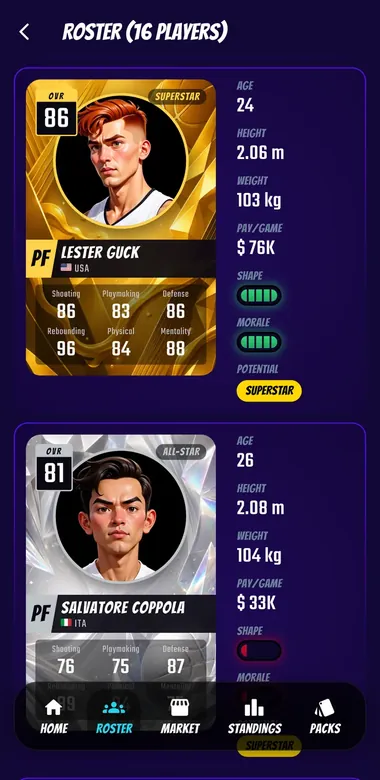
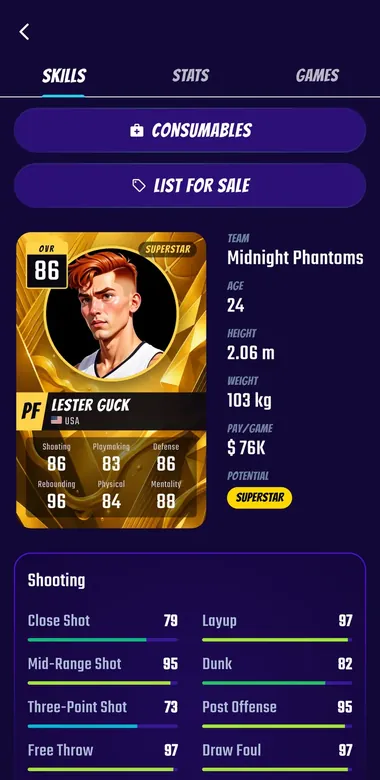
The skill names are the ones you see on the player cards.
| Position | Key skills | Why |
|---|---|---|
| Point guard | Ball Security, Decision Making, Pick & Roll Handler, Three-Point Shot, Speed | He makes decisions at speed on most possessions: ball security offsets the system's turnover risk. |
| Shooting guard | Three-Point Shot, Catch and Shoot, Transition Offense, Speed | The trail shooter on the break and the main kick-out target. |
| Small forward | Transition Offense, Speed, Three-Point Shot, Layup | Runs the floor and finishes at the rim or from the arc. |
| Power forward | Three-Point Shot and Catch and Shoot of 70 or more, Defensive Rebound, Speed | A stretch four keeps the floor spaced and helps on the defensive glass. |
| Center | Three-Point Shot and Catch and Shoot (80+ to pop), Screening, Defensive Rebound, Box Out | Pops out of the pick-and-roll, and protects a team that gives up offensive rebounds. |
Two more checks: Transition Defense, because a faster game means more possessions the other way too, and a deep bench if you combine it with a fast defense, since more possessions mean more contact and more fouls over a game.
Pace and Space matchups
Measured in the tactics lab (October 2026): Pace and Space against each of the eight defenses, with 1,404 games per matchup between identical teams and a margin of error of about ±2.6 points.
| Defense | Win % | Points per 100 possessions | Turnovers |
|---|---|---|---|
| Drop Coverage | 56.1% | 120.4 | 12.3 |
| Pack Line | 55.8% | 120.1 | 12.2 |
| No-Middle | 49.1% | 116.4 | 12.8 |
| Man-to-Man | 49.1% | 116.5 | 14.1 |
| Match-Up Zone | 48.2% | 116.1 | 10.8 |
| Half-Court Trap | 48.1% | 115.9 | 18.1 |
| Full-Court Press | 47.1% | 114.9 | 19.9 |
| Switch-Everything | 44.5% | 114.2 | 14.1 |
The three rules that decide these matchups are explained in the matchup section of the study.
Which defense to pair with pace and space
- Switch-Everything: the same versatile wings who shoot can switch on defense. Watch out for teams that attack the paint.
- Full-Court Press: maximum chaos and maximum possessions, if you are the stronger team, have guards with Steal and Perimeter Defense and a deep bench.
- Avoid Pack Line if you want tempo: its slower defensive pace drags your games back toward normal.
Common pace and space mistakes
- Running it without shooters. Speed without spacing just produces quick misses.
- A loose point guard. Low Ball Security is a poor fit for a system that makes decisions at speed, especially against pressure: in the tactics lab Pace and Space wins only 47.1% against the Full-Court Press.
- Using it as the underdog. More possessions favor the better team: an outmatched team does better with a slow system such as the Princeton.
Related offenses
- 5-Out Offense: almost as many threes at a normal tempo, with more ball movement and a lower turnover risk (×0.93).
- Small Ball: the same tempo with smaller lineups and even more fast breaks.
- Run and Gun: the fastest system in the game, attacking the rim as well as the arc.
Frequently asked questions
What does pace and space mean in basketball?
Pace and space is a style that combines a fast tempo with wide floor spacing. Teams push the ball before the defense is set and surround the ball handler with shooters, generating a high volume of threes and open driving lanes.
Who invented pace and space?
The style is most associated with Mike D'Antoni's Phoenix Suns of the mid-2000s, the "Seven Seconds or Less" teams led by two-time MVP Steve Nash. D'Antoni later pushed it further in Houston, where his Rockets set NBA records for three-point attempts.
Does pace and space shoot the most threes in Swish & Dunk?
Yes. Its three-point tendency of ×1.35 is the highest of all fifteen offenses, ahead of 5-Out and Small Ball (×1.30).
Does a faster pace tire my players more?
No. In Swish & Dunk fatigue depends on time on the floor, which is the same at any pace. A faster pace means more possessions, which favors the more talented team, and a bit more contact over a game.
What is the best defense against pace and space?
Switch-Everything and Full-Court Press are the defenses that beat Pace and Space most often in the Swish & Dunk tactics lab: Pace and Space wins only 44.5% and 47.1% of games against them, over 1,404 games per matchup. Its best matchups are Drop Coverage (56.1%) and Pack Line (55.8%).
Pace and Space is one of fifteen offensive systems in the game: the complete tactics guide compares them all, together with the eight defenses. The engine's shot model was recalibrated against real NBA data: read what changed in the new match engine.
New to the genre? Start from our ranking of the best basketball manager games for browser, Android and iOS.
Push the pace with your own club: sign up for free and play your first game tomorrow.

- Free
- No ads
- 21 languages
- Android 7.0+
- iOS 15.0+


Sources
Last updated: