Tactics · Offense · 7 min read
Small Ball: how it works, how Swish & Dunk simulates it and which players it needs
Small Ball trades size for speed: forwards at the big positions, five players who can shoot and run, and an opponent dragged away from the paint. In Swish & Dunk it is the system that attacks the rim least and one of the fastest, with the second-highest number of fast breaks. This guide explains how small ball works, exactly how the match engine simulates it and which skills your cards need to make the trade worth it.
Small Ball at a glance
- Identity: small, quick, versatile lineups that run and shoot.
- In the engine: three-point weight ×1.30, paint ×0.80 (the lowest in the game), pace ×0.90, transition ×1.20, pick-and-roll ×1.10, ball movement ×1.05, offensive rebounding ×0.80. Turnover risk ×0.95, the second lowest after 5-Out.
- Key skills: Three-Point Shot, Speed and Transition Offense on wings and forwards; Defensive Rebound and Box Out to limit the damage on the glass.
- Best against: Drop Coverage (58.5%) and Pack Line (56.4%). Worst against: Switch-Everything (42.5%) and Full-Court Press (46.2%).
What is small ball?
Small ball means playing without a traditional center, or with forwards in the big-man spots, to put more speed, shooting and ball handling on the floor. The opponent's big man must either guard a quicker player on the perimeter or leave him open.
Don Nelson experimented with it for decades; his 2007 "We Believe" Warriors used it to upset the top-seeded Dallas Mavericks. The Miami Heat won titles in 2012 and 2013 with LeBron James at power forward. Then the Golden State Warriors' "Death Lineup", with Draymond Green at center, made it the defining style of the 2010s, and the 2019-20 Houston Rockets took it to the extreme with P.J. Tucker, listed at 6'5", starting at center.
How small ball works on the court
- Five players who can shoot, so the lane stays open and closeouts are long.
- Run after every defensive rebound to beat bigger, slower opponents up the floor.
- Switch on defense: with similar-sized players, every screen can be switched without a mismatch.
- Make the big man defend in space: the opposing center has to guard a shooter far from the basket.
The cost is size: fewer offensive rebounds, less rim protection, and a defense that can be punished by a dominant post player.
How Swish & Dunk simulates small ball
The Swish & Dunk match engine simulates every possession as a chain of decisions, and a tactic multiplies the weight of the options at each step. These are Small Ball's levers compared with the neutral value of 1.00:
| Lever | Small Ball | What it means in a game |
|---|---|---|
| Pace | ×0.90 | Shorter possessions. Against a neutral defense, about 5% shorter. |
| Three-point shots | ×1.30 | A strong lean toward the arc, tied with 5-Out. |
| Paint shots | ×0.80 | The fewest shots at the rim of any offense. |
| Pick-and-roll | ×1.10 | More two-man game. |
| Transition | ×1.20 | About 18% of possessions start as fast breaks, second only to Run and Gun. |
| Ball movement | ×1.05 | Slightly more kick-outs and assists. |
| Turnover risk | ×0.95 | Rebalanced in October 2026: 13.4 turnovers per game in the tactics lab, in a range of 12.5–15.7 across the fifteen offenses. |
| Offensive rebounding | ×0.80 | The second lowest after 5-Out: few second chances. |
The tactic does not pick your lineup
The most important thing to understand: choosing Small Ball does not make your lineup smaller. The tactic changes how your players behave; who plays is decided in the Set Lineup screen. Run Small Ball with two traditional centers and you get a team that avoids the paint even though its best scorers live there. To get the real effect, pair the tactic with a lineup of forwards and wings.
Size has real effects in the engine. On the boards, every player's weight is scaled by height (about 1.5% per centimeter from 195 cm, within limits) and by position, with centers and power forwards favored. At the rim, every centimeter above 198 cm adds a little to the chance of making a close shot and every centimeter below takes a little away, up to 6 percentage points either way. A smaller lineup gives up on both counts, which is exactly why the tactic steers it away from the paint.
Shot selection and fast breaks
When a player creates his own shot, the engine weighs a three, a mid-range jumper and a finish at the rim using his ratings, his position and the tactic. An illustrative shooting guard with 80 from three takes about 67% of his own shots from deep in Small Ball against 58% in a balanced offense, and only 19% at the rim. A stretch big with 80 from outside takes about 44% of his shots from three and pops out of about 75% of his screens.
About 18% of possessions start as fast breaks. The ball goes to the player with the best Transition Offense and Speed, and the shooter is chosen by Transition Offense, Speed, Layup and Three-Point Shot. With the highest ratio of three-point to paint weight in the game, Small Ball's fast breaks end in trail threes more often than any other system's. Transition shots get a bonus of up to 12 percentage points, reduced by the defender's Transition Defense.
Matchups are by position
Each shot is contested by the defender who shares the shooter's primary position. When you go small and leave out a center, the opposing center is guarded by whichever of your players the engine picks, and your extra wing faces their wing. Small Ball hides a weak interior defender, but it also means nobody in your lineup is built to contest their big at the rim.
The ideal small ball players and the skills to look for
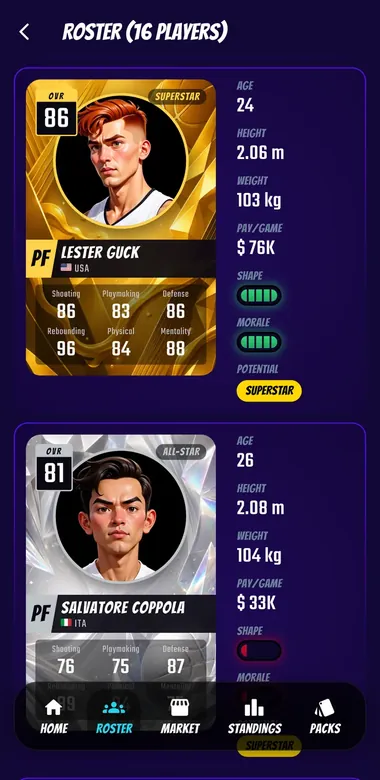
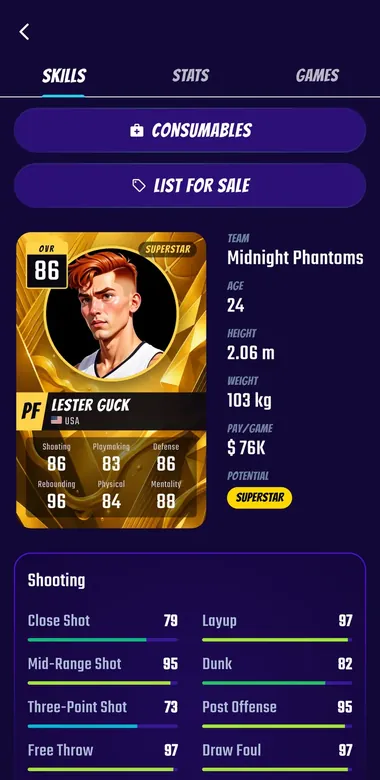
The skill names are the ones you see on the player cards.
| Position | Key skills | Why |
|---|---|---|
| Point guard | Speed, Transition Offense, Pick & Roll Handler, Three-Point Shot | Pushes the ball and runs the extra pick-and-rolls. |
| Shooting guard | Three-Point Shot, Catch and Shoot, Speed | The trail shooter on the break and the kick-out target. |
| Small forward | Transition Offense, Speed, Three-Point Shot, Perimeter Defense | The prototype small ball player: runs, shoots and defends in space. |
| Power forward | Three-Point Shot, Defensive Rebound, Box Out, Strength | A forward who shoots but still fights on the glass. |
| Center (or a forward in the slot) | Defensive Rebound, Box Out, Strength, Screening, Three-Point Shot | The rebounding gap is the system's main cost: limit it here. |
Small Ball is a natural fit for rosters full of wings. If your best cards are forwards with Speed, Three-Point Shot and Perimeter Defense, and your centers are weak, this is the system that hides the weakness and amplifies the strength.
Small Ball matchups
Measured in the tactics lab (October 2026): Small Ball against each of the eight defenses, with 1,404 games per matchup between identical teams and a margin of error of about ±2.6 points.
| Defense | Win % | Points per 100 possessions | Turnovers |
|---|---|---|---|
| Drop Coverage | 58.5% | 120.8 | 11.4 |
| Pack Line | 56.4% | 119.5 | 11.4 |
| No-Middle | 52.8% | 117.4 | 11.7 |
| Man-to-Man | 50.9% | 116.9 | 13.1 |
| Half-Court Trap | 49.5% | 116.1 | 16.9 |
| Match-Up Zone | 46.4% | 116.6 | 9.9 |
| Full-Court Press | 46.2% | 115.0 | 18.8 |
| Switch-Everything | 42.5% | 115.1 | 13.2 |
The three rules that decide these matchups are explained in the matchup section of the study.
Which defense to pair with small ball
- Switch-Everything: the classic pairing. Players of similar size can switch every screen. Be aware that Switch-Everything also weakens your defensive rebounding (×0.95), on top of a small lineup.
- Man-to-Man: the safer choice if your wings defend well one on one and you can't afford to lose more rebounds.
- Avoid Match-Up Zone and Full-Court Press without strong rebounders: they are the weakest defenses on the glass, and Small Ball already gives up size.
Common small ball mistakes
- Picking the tactic but not the lineup. Two traditional bigs in a Small Ball system shoot fewer shots at the rim for no reason.
- Forgetting the defensive glass. Small Ball gives up offensive rebounds by design; losing the defensive ones too is fatal.
- Going small against a switching defense. Switch-Everything is its worst matchup.
Related offenses
- Pace and Space: the same tempo and three-point volume, with a little more paint and rebounding.
- 5-Out Offense: five-out spacing at a normal tempo.
- Run and Gun: even more fast breaks, attacking the rim as well as the arc.
Frequently asked questions
What is small ball in basketball?
Small ball means playing a lineup without a traditional center, or with forwards at the big positions, to gain speed, shooting and switchability. Teams accept a size disadvantage on the boards in exchange for space, pace and threes.
Which teams made small ball famous?
Don Nelson's Warriors and Mavericks experimented with it for years, the Miami Heat won titles with LeBron James at power forward, and the Golden State Warriors' "Death Lineup" with Draymond Green at center made it the defining style of the 2010s. The 2019-20 Houston Rockets took it to the extreme with P.J. Tucker at center.
Does choosing Small Ball change my lineup in Swish & Dunk?
No. The tactic changes how your team plays, not who plays. To really go small you have to pick smaller, faster players in the Set Lineup screen. Running Small Ball with two traditional bigs wastes much of its value.
Why does small ball lose rebounds?
Rebounding in Swish & Dunk weighs skill, strength, position and height. Small Ball also has an offensive rebounding tendency of ×0.80, the second lowest of all offenses, so second chances become rare.
What beats small ball?
Switch-Everything and Full-Court Press are the defenses that beat Small Ball most often in the Swish & Dunk tactics lab: Small Ball wins only 42.5% and 46.2% of games against them, over 1,404 games per matchup. Its best matchups are Drop Coverage (58.5%) and Pack Line (56.4%).
Small Ball is one of fifteen offensive systems in the game: the complete tactics guide compares them all, together with the eight defenses. To see how the real NBA moved toward smaller, three-point-heavy lineups, read our analysis of 30 NBA seasons.
Still choosing a basketball manager game? Our ranking compares the best ones on depth, simulation and monetization.
Go small with your own club: sign up for free and play your first game tomorrow.

- Free
- No ads
- 21 languages
- Android 7.0+
- iOS 15.0+


Sources
- Small ball (basketball) — Wikipedia
- Death Lineup — Wikipedia
- 2006–07 Golden State Warriors season — Wikipedia
Last updated: