Tactics · Offense · 9 min read
5-Out Offense: how it works, how Swish & Dunk simulates it and which players it needs
The 5-Out offense is the purest expression of modern spacing: five players outside the arc, an empty paint and a defense forced to choose between helping on drives and staying home on shooters. This guide explains how the 5-Out works in real basketball, exactly how the Swish & Dunk match engine simulates it and which player skills you need on your cards to make it work.
5-Out at a glance
- Identity: threes, drives into an open lane and kick-outs to the open man.
- In the engine: three-point weight ×1.30, paint weight ×0.90, pick-and-roll ×1.10, ball movement ×1.10, offensive rebounding ×0.75 (the lowest in the game). Normal tempo and transition; turnover risk ×0.93, the lowest of all fifteen offenses.
- Key skills: Three-Point Shot and Catch and Shoot at all five positions, Off-Ball Movement, a Pick & Roll Handler at point guard.
- Best against: Drop Coverage (57.1%) and Pack Line (54.6%). Worst against: Match-Up Zone (47.3%) and No-Middle (48.1%).
What is the 5-Out offense?
In a 5-Out set every player starts outside the three-point line: usually two players at the top, two on the wings and one in the corner, or two in the corners. Nobody occupies the low post. That empty paint is the whole point. Every drive goes straight to the rim without a second big waiting there, and every defender who slides over to help leaves a shooter open behind the arc.
The idea grew out of the dribble-drive motion offense developed by Vance Walberg at junior-college level and popularized by John Calipari at Memphis in the 2000s. The NBA adopted it as three-point shooting spread to every position: the Milwaukee Bucks of the late 2010s, with a center like Brook Lopez camped behind the arc to open the lane for Giannis Antetokounmpo, are a textbook example. Today almost every NBA team spends long stretches of the game in 5-Out spacing.
How the 5-Out works on the court
The 5-Out is not a set play but a spacing framework with a few recurring actions:
- Drive and kick. A player attacks a closeout, collapses the defense and passes out to the shooter whose defender helped.
- Drive and fill. When a player drives, teammates rotate one spot over so the passing lanes and the shooting pockets stay filled.
- Backdoor cuts. If a defender overplays the passing lane, the empty paint makes the backdoor cut the easiest basket on the floor.
- High pick-and-roll with a popping big. The screener steps out for a three instead of rolling, pulling the last rim protector away from the basket.
The weakness is structural: with nobody near the basket, there is no one to grab offensive rebounds and no easy post touch when the shots stop falling.
How Swish & Dunk simulates the 5-Out
The Swish & Dunk match engine simulates every possession as a chain of decisions. A tactic does not script any play: it multiplies the weight of each option, while your players' ratings still decide who does what and how well. These are the 5-Out's levers compared with the neutral value of 1.00:
| Lever | 5-Out | What it means in a game |
|---|---|---|
| Pace | ×1.00 | Normal possession length. |
| Three-point shots | ×1.30 | Every shot decision leans heavily toward the arc. Only Pace and Space (×1.35) goes further. |
| Paint shots | ×0.90 | Fewer shots at the rim than a balanced offense. |
| Pick-and-roll | ×1.10 | A little more two-man game, and bigs who can shoot pop out more often. |
| Transition | ×1.00 | About 15% of possessions start as fast breaks, like a balanced team. |
| Ball movement | ×1.10 | More kick-outs to shooters and more assisted baskets. |
| Turnover risk | ×0.93 | Rebalanced in October 2026: 12.5 turnovers per game in the tactics lab, in a range of 12.5–15.7 across the fifteen offenses. |
| Offensive rebounding | ×0.75 | The lowest of all fifteen offenses: second chances become rare. |
Shot selection: where the 5-Out really bites
When a player creates his own shot, the engine weighs a three, a mid-range jumper and a shot at the rim using his ratings, his position and the tactic. Take an illustrative shooting guard with 80 in Three-Point Shot and Catch and Shoot: with a balanced offense, about 58% of the shots he creates are threes; in the 5-Out that rises to about 65%, while his attempts at the rim drop from 27% to 21%.
The multiplier works through the player, not instead of him. Every player's willingness to shoot threes is first scaled by his outside shooting: below an average of 70 between Three-Point Shot and Catch and Shoot it starts to shrink, and at 35 or less it falls to a minimum. A non-shooter in the 5-Out still takes very few threes; he just takes fewer shots at the rim. That is why the 5-Out without shooters is just a team that misses from far away.
The stretch big is the key piece
Centers and power forwards normally have a strong positional bias toward the paint. In Swish & Dunk that bias fades as their outside shooting rises: from an average of 60 in Three-Point Shot and Catch and Shoot a big starts behaving like a wing, and from 85 he shoots threes as freely as a small forward. A traditional center with 30 from three takes almost no threes in any system; a center with 80 from three takes about 41% of his own shots from deep in the 5-Out, against 33% in a balanced offense.
The pick-and-roll adds a second boost. When a big who can shoot sets a screen, the engine decides whether he rolls to the rim or pops out for a jumper, and the tactic's three-point tendency scales that choice. In the 5-Out a center with 80 from outside pops on about 75% of his screens, the maximum the engine allows, against 60% with a balanced offense.
Kick-outs and assists
In the half court the ball usually ends up with a point guard or a guard who handles and passes well. He then picks between an isolation, a pick-and-roll, a post-up and a kick-out to a teammate. The 5-Out raises both the pick-and-roll (×1.10) and the kick-out (×1.10). For a typical playmaking point guard that means about a third of his plays are pick-and-rolls and more than one in five is a kick-out. On a kick-out the shooter is chosen among teammates by Catch and Shoot, Three-Point Shot and Off-Ball Movement, so the players who move well without the ball get the shots. Ball movement also raises the chance that a made basket is assisted.
The price: rebounds
On every miss the ten players compete for the ball, weighted by rebounding, Box Out, Strength, position and height, and multiplied by the attacking tactic's offensive rebounding tendency. At ×0.75 the 5-Out gives up a quarter of its weight on the offensive glass. Against a defense that is already strong on the boards, such as Pack Line or Drop Coverage, second shots almost disappear. The 5-Out has to win through shooting efficiency, not volume.
The ideal 5-Out players and the skills to look for
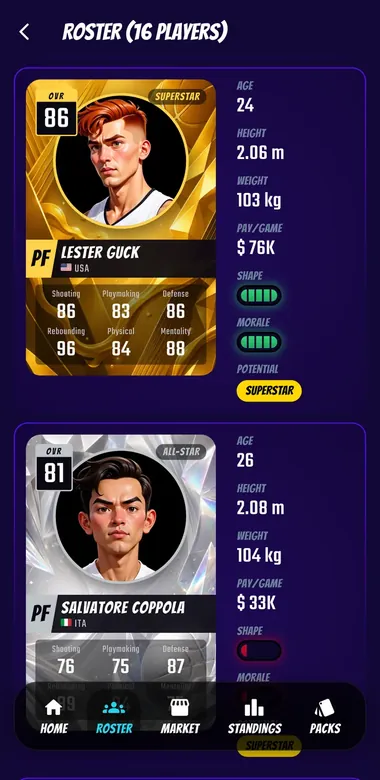
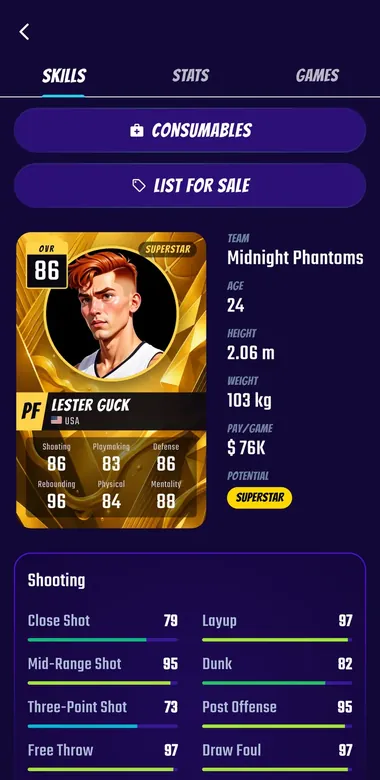
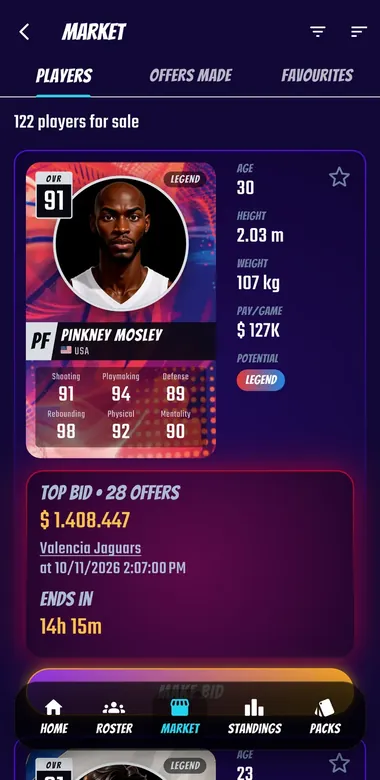
When you scout cards on the market or in packs, these are the skills that make the 5-Out work. The skill names are the ones you see on the player cards.
| Position | Key skills | Why |
|---|---|---|
| Point guard | Pick & Roll Handler, Ball Handle, Pass Accuracy, Court Vision, Three-Point Shot | He starts most plays: the pick-and-roll and the kick-out weights depend on these ratings. |
| Shooting guard | Three-Point Shot, Catch and Shoot, Off-Ball Movement | The main beneficiary of kick-outs and of the ×1.30 three-point weight. |
| Small forward | Three-Point Shot, Catch and Shoot, Layup, Draw Foul | A wing who punishes closeouts both from the arc and on the drive. |
| Power forward | Three-Point Shot and Catch and Shoot of 70 or more, Defensive Rebound, Box Out | He must shoot to keep the paint empty, and help a team that rebounds poorly. |
| Center | Three-Point Shot and Catch and Shoot of 80 or more, Screening, Defensive Rebound | The stretch five who pops out of the pick-and-roll is the system's signature piece. |
Two secondary checks. Ball Security and Decision Making on your main handler: the 5-Out does not add turnover risk, but it does not protect you either. And defensive rebounding on your bigs: your team will lose the offensive glass, so it cannot afford to lose the defensive one too.
Roster rule of thumb: run the 5-Out when at least four of your five starters have an outside shooting average of 70 or more, and at least one of them is a big.
5-Out matchups: which defenses it beats
Measured in the tactics lab (October 2026): 5-Out against each of the eight defenses, with 1,404 games per matchup between identical teams and a margin of error of about ±2.6 points.
| Defense | Win % | Points per 100 possessions | Turnovers |
|---|---|---|---|
| Drop Coverage | 57.1% | 119.8 | 10.4 |
| Pack Line | 54.6% | 119.5 | 10.9 |
| Half-Court Trap | 49.4% | 116.8 | 15.7 |
| Man-to-Man | 49.2% | 116.6 | 12.3 |
| Full-Court Press | 48.7% | 116.5 | 17.3 |
| Switch-Everything | 48.6% | 115.2 | 12.4 |
| No-Middle | 48.1% | 115.8 | 11.1 |
| Match-Up Zone | 47.3% | 116.0 | 9.4 |
The three rules that decide these matchups are explained in the matchup section of the study.
Which defense to pair with the 5-Out
The same five players play both ends, so the defense has to suit the personnel the 5-Out asks for: shooters and mobile bigs, often without a true rim protector.
- Switch-Everything: the natural partner. Versatile players who shoot can also switch on the perimeter. The risk is a team that pounds the paint.
- Match-Up Zone: a good perimeter contest without needing elite individual defenders, but it rebounds poorly, and so does the 5-Out.
- Avoid Drop Coverage unless you also have a real rim protector: a stretch five who shoots well rarely blocks shots too.
Common 5-Out mistakes
- Running it with a traditional center. If your center has 40 from three, the system's best lever is dead on that position.
- Ignoring the defensive glass. You already give up offensive rebounds; losing the defensive ones too turns every game into a possession deficit.
- Sticking with it against switching defenses. Match-Up Zone (47.3%) is its worst matchup in the tactics lab, followed by No-Middle (48.1%) and Switch-Everything (48.6%): adapt for that game.
- Picking it for a team of slashers. If your wings live on Layup and Dunk but cannot shoot, a paint system gets more out of them.
Related offenses
- Pace and Space: the same three-point philosophy with a faster tempo and more fast breaks.
- Small Ball: spacing through smaller, quicker lineups, at the cost of rebounding.
- Spread Pick-and-Roll: the same spacing built around one two-man game.
- Motion Offense: the read-and-react cousin, with more passing and fewer threes.
Frequently asked questions
What is a 5-out offense in basketball?
A 5-out offense puts all five players outside the three-point line. With nobody parked in the paint, the lane stays open for drives and cuts, and every defender who helps on a drive leaves a shooter open on the perimeter.
Can you run a 5-out offense without a center who shoots threes?
You can, but you lose most of its value. A center who can't shoot lets his defender sag into the paint and close the driving lanes. In Swish & Dunk a big man with low Three-Point and Catch and Shoot ratings barely takes threes, so the system's main lever is wasted on him.
Why does 5-Out lose the rebounding battle?
With all five players far from the basket, nobody is in position for a second shot. In Swish & Dunk the 5-Out has the lowest offensive rebounding tendency of all fifteen offenses (×0.75).
Which defense stops the 5-Out offense?
Match-Up Zone and No-Middle are the defenses that beat 5-Out most often in the Swish & Dunk tactics lab: 5-Out wins only 47.3% and 48.1% of games against them, over 1,404 games per matchup. Its best matchups are Drop Coverage (57.1%) and Pack Line (54.6%).
Is 5-Out the same as Pace and Space?
No. Both rely on threes, but 5-Out plays at a normal tempo and runs more pick-and-rolls and kick-outs, while Pace and Space speeds the game up and adds fast breaks. 5-Out also has a lower turnover risk.
The 5-Out is one of fifteen offensive systems in the game: the complete tactics guide compares them all, together with the eight defenses. To see why the three-point shot dominates today's game, read our analysis of 30 NBA seasons, and to learn how stretch bigs were added to the engine, see what changed in the new match engine.
New to the genre? Start from our ranking of the best basketball manager games for browser, Android and iOS.
Build your five-shooter lineup: take over a club for free and play your first game tomorrow.

- Free
- No ads
- 21 languages
- Android 7.0+
- iOS 15.0+


Sources
- Dribble drive motion — Wikipedia
- Vance Walberg — Wikipedia
- Historical NBA data and player box scores — Kaggle
Last updated: