Tactics · Offense · 8 min read
Princeton Offense: how it works, how Swish & Dunk simulates it and which players it needs
The Princeton offense is the art of winning without the better athletes: four players spaced around the arc, a passing big at the high post, constant cuts and the patience to wait for one defensive mistake. In Swish & Dunk it is one of the two slowest systems in the game and the one that moves the ball most. This guide explains how the Princeton works, exactly how the match engine simulates it and which skills your cards need to run it.
Princeton Offense at a glance
- Identity: backdoor cuts, passing, patience and very few mistakes.
- In the engine: ball movement ×1.30 and turnover risk ×0.99, pace ×1.15 and transition ×0.75 (second only to Half-Court Control), paint ×1.15, three-point ×1.05, pick-and-roll ×0.75, offensive rebounding ×1.00.
- Key skills: Basketball IQ, Decision Making and Ball Security at every position, Pass Accuracy and Court Vision on the bigs, Close Shot and Layup to finish cuts.
- Best against: Full-Court Press (56.7%), Half-Court Trap (54.6%) and Switch-Everything (54.6%). Worst against: Pack Line (46.5%) and Drop Coverage (46.8%).
What is the Princeton offense?
The Princeton offense was developed by Pete Carril, head coach at Princeton University from 1967 to 1996. Carril's teams rarely had the size or speed of their opponents, so he built a system that made talent less decisive: everyone handles, everyone passes, and the offense attacks the defense's aggressiveness instead of trying to overpower it.
Its most famous moment came in the first round of the 1996 NCAA tournament, when Princeton beat defending national champion UCLA 43-41, with the winning basket coming on a backdoor layup. In the NBA, Princeton principles shaped the Sacramento Kings of the early 2000s, with Carril on the bench as an assistant and passing bigs like Chris Webber and Vlade Divac, and the New Jersey Nets that reached the 2002 and 2003 Finals with assistant coach Eddie Jordan installing the system.
How the Princeton offense works on the court
- Four out, one in at the high post. The center plays near the free-throw line as a passer, not as a scorer with his back to the basket.
- The backdoor cut. When a defender overplays the passing lane, the attacker cuts behind him to the basket and receives a bounce pass for a layup. It is the system's signature play.
- Dribble handoffs and chin series keep the ball moving between the perimeter and the high post.
- Patience. Possessions often run deep into the shot clock: a good shot is not enough when a great one may come.
The style lowers the total number of possessions, limits mistakes and turns games into tight, low-scoring contests where a few defensive lapses decide the result.
How Swish & Dunk simulates the Princeton offense
The Swish & Dunk match engine simulates every possession as a chain of decisions, and a tactic multiplies the weight of the options at each step. The engine does not draw individual cuts on a whiteboard: it reproduces their effect on the possession. These are the Princeton's levers compared with the neutral value of 1.00:
| Lever | Princeton | What it means in a game |
|---|---|---|
| Pace | ×1.15 | The longest possessions in the game after Half-Court Control. Against a neutral defense, about 7.5% longer than a balanced team. |
| Three-point shots | ×1.05 | A slight lean toward the arc for players who can shoot. |
| Paint shots | ×1.15 | More finishes at the rim: the outcome of cuts and of a passing big. |
| Pick-and-roll | ×0.75 | Little two-man game. |
| Transition | ×0.75 | Only about 11% of possessions start as fast breaks, fewer than any offense except Half-Court Control. |
| Ball movement | ×1.30 | The most kick-outs and assists in the game. |
| Turnover risk | ×0.99 | Rebalanced in October 2026: 13.7 turnovers per game in the tactics lab, in a range of 12.5–15.7 across the fifteen offenses. |
| Offensive rebounding | ×1.00 | Neutral. |
Pressure: why the press and the trap struggle against it
Every possession starts with a duel between the ball handler and his direct defender: Ball Security (45%), Decision Making (35%) and Basketball IQ (20%) against the defender's Perimeter Defense and Steal, multiplied by the defensive tactic's pressure and the offensive tactic's turnover risk. Since the October 2026 rebalance the Princeton's turnover risk is ×0.99, practically neutral: in the tactics lab it loses 13.7 balls per game, in line with the other offenses. What still beats pressure is ball movement, ×1.30 and the highest in the game: every pass that escapes a double team leaves a defender out of position, and the engine rewards it on the shot. The Princeton beats the Full-Court Press in 56.7% of games and the Half-Court Trap in 54.6%, its two best matchups.
The ball goes to the passers
In the half court the engine picks who handles the ball by position and by Ball Handle (55%), Pass Accuracy (25%) and Court Vision (20%). He then chooses between an isolation, a pick-and-roll, a post-up and a kick-out. The Princeton cuts the pick-and-roll to ×0.75 and raises the kick-out to ×1.30: for a typical playmaking point guard, pick-and-rolls drop from about 32% to 24% of his plays while kick-outs rise from 21% to about 28%.
Kick-outs send the shot to the teammate with the best mix of Catch and Shoot, Three-Point Shot and Off-Ball Movement, and ball movement raises the chance that a made basket is assisted. Bigs with good Pass Accuracy and Court Vision are picked as handlers more often than other bigs, and when a center or power forward with good Post Offense has the ball, the post-up becomes his most likely play.
Shot selection: closer to the rim
When a player creates his own shot, the paint weight of ×1.15 moves attempts toward the basket. An illustrative shooting guard with 80 from three takes about 29% of his own shots at the rim in the Princeton, against 27% in a balanced offense, while his three-point share barely moves (57% against 58%). A stretch center with 80 from outside takes about 62% of his own shots at the rim and pops out of about 63% of his screens. The Princeton is not a three-point system: it turns patience into layups.
Slow pace: why it helps the underdog
The length of a possession is the average of the attacking team's offensive pace and the defending team's defensive pace. With ×1.15 on your side and only 11% of possessions in transition, games have fewer possessions. Fewer possessions leave more room for variance, and variance is what an underdog needs. If your roster is weaker than the opponent's, the Princeton shortens the game and keeps it close. If you are the favorite, it does the opposite: it gives the weaker team more chances to steal the win.
The ideal Princeton offense players and the skills to look for
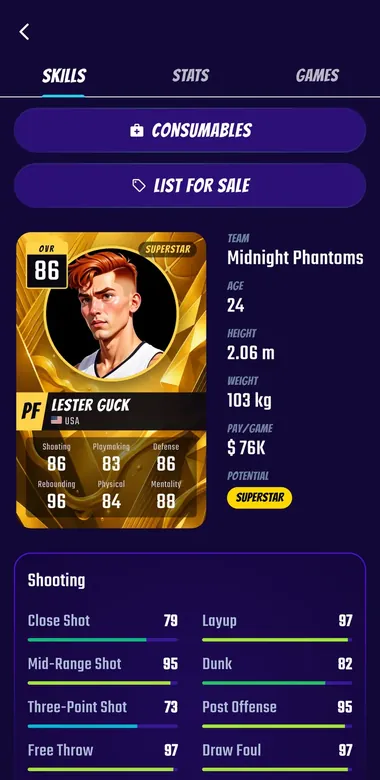
The Princeton is the system where mental and passing skills matter more than athleticism. The skill names are the ones you see on the player cards.
| Position | Key skills | Why |
|---|---|---|
| Point guard | Ball Security, Decision Making, Basketball IQ, Pass Accuracy, Court Vision | He fights the turnover duel on most possessions and creates the kick-outs. |
| Shooting guard | Off-Ball Movement, Catch and Shoot, Layup, Ball Security | The cutter and spot-up shooter who finishes what the passers create. |
| Small forward | Off-Ball Movement, Layup, Close Shot, Pass Accuracy | Cuts to the rim and keeps the ball moving. |
| Power forward | Pass Accuracy, Court Vision, Close Shot, Post Offense | A big who passes handles the ball more and finishes inside. |
| Center | Pass Accuracy, Court Vision, Close Shot, Basketball IQ, Screening | The high-post hub: passing first, finishing second. |
What you can skip: elite Speed and Transition Offense, which the Princeton rarely uses, and an elite Pick & Roll Handler. That makes it a good system for a roster built on value: players with high IQ and passing but average athleticism are often cheaper on the market.
Mentality skills also matter at the end of games. In clutch time the engine adds Clutch, experience and Leadership to the turnover and shooting duels, and in a slow system like the Princeton, with few possessions, every wasted ball weighs more.
Princeton Offense matchups
Measured in the tactics lab (October 2026): Princeton against each of the eight defenses, with 1,404 games per matchup between identical teams and a margin of error of about ±2.6 points.
| Defense | Win % | Points per 100 possessions | Turnovers |
|---|---|---|---|
| Full-Court Press | 56.7% | 118.0 | 18.5 |
| Half-Court Trap | 54.6% | 117.6 | 17.0 |
| Switch-Everything | 54.6% | 117.9 | 13.4 |
| Match-Up Zone | 52.6% | 117.2 | 10.2 |
| Man-to-Man | 52.1% | 117.3 | 13.3 |
| No-Middle | 51.1% | 116.5 | 11.9 |
| Drop Coverage | 46.8% | 115.5 | 11.6 |
| Pack Line | 46.5% | 115.8 | 11.7 |
The three rules that decide these matchups are explained in the matchup section of the study.
Which defense to pair with the Princeton
- Drop Coverage: "the patient team". Few possessions, very few turnovers, a protected rim. Ideal for a less talented roster that wants to stay in games.
- Pack Line or Match-Up Zone: both slow the opponent's possessions too (×1.05), shortening the game further, which is exactly what an underdog wants.
- Avoid Full-Court Press if you chose the Princeton to control the tempo: the press speeds the game up and undoes it.
Common Princeton mistakes
- Running it as the favorite. If you are clearly stronger, a slow game only gives the opponent more variance to work with.
- Bigs who can't pass. Without Pass Accuracy and Court Vision on your bigs, the ball stays with the guards and the system loses its center.
- Expecting threes. The Princeton creates rim attempts and avoids mistakes; it does not create a three-point volume edge.
Related offenses
- Motion Offense: the same read-and-react philosophy at a normal tempo, with a more balanced shot diet.
- Triangle Offense: another patient system, built around the post and the offensive glass.
- Run and Gun: the exact opposite, the fastest and riskiest offense in the game.
Frequently asked questions
What is the Princeton offense?
The Princeton offense is a patient, passing-based system created by Pete Carril at Princeton University. Four players spread around the perimeter and a passing big at the high post keep the ball moving until a defender overplays, then a backdoor cut produces an easy basket.
Why is the Princeton offense good for underdogs?
It slows the game down. Fewer possessions mean more variance, which gives the weaker team a better chance of an upset. Princeton's famous 43-41 win over defending champion UCLA in the 1996 NCAA tournament is the classic example.
Is the Princeton the slowest offense in Swish & Dunk?
Not any more. Its pace multiplier of ×1.15 and transition tendency of ×0.75 make it the second slowest system in the game, behind Half-Court Control (×1.25 and ×0.60), added in October 2026. It is still the offense that moves the ball most.
Does the Princeton offense need a center who can pass?
It works much better with one. In Swish & Dunk the player who brings the ball is chosen partly on Pass Accuracy and Court Vision, so a big who passes well handles the ball more often and keeps possessions moving.
What defense beats the Princeton offense?
Pack Line and Drop Coverage are the defenses that beat Princeton most often in the Swish & Dunk tactics lab: Princeton wins only 46.5% and 46.8% of games against them, over 1,404 games per matchup. Its best matchups are Full-Court Press (56.7%) and Half-Court Trap (54.6%).
The Princeton is one of fifteen offensive systems in the game: the complete tactics guide compares them all, together with the eight defenses. For the bigger picture of how the game's offenses evolved, read how the NBA has changed in 30 years.
Still choosing a basketball manager game? Our ranking compares the best ones on depth, simulation and monetization.
Out-think stronger teams: take over a club for free and play your first game tomorrow.

- Free
- No ads
- 21 languages
- Android 7.0+
- iOS 15.0+


Sources
Last updated: